Showing posts with label Kohler. Show all posts

16 April 2015

Hyatt / Paramore / Hunt families

Levi Alderman Hunt and Lucinda Elvira Hyatt Paramore Hunt Family:
Ethel Lorean Hunt (Tanner), Edith Hunt (Moore), Levi Ray Hunt, Jessie Mardelain Hunt (Mulliner), Ruby Hunt (Nielsen), Leonard Hunt, Estella Paramore Hunt (Thompson), Amy Alberta Hunt (Hooker), Lucinda Elvira Hyatt (Paramore) (Hunt), Leland Hunt, and Levi Alderman Hunt


Lucinda Elvira Hyatt was born 8 Apr 1860 in Parowan, Iron county, Utah, the third of six children of John Smith Defreeze Hyatt and his first wife, Martha Jane Turner Howd. Lucinda was baptized in the Church of Jesus Christ of Latter-day Saints on 18 Oct 1872.

Before 1879 Lucinda married Hyrum Duckworth Paramore. Hyrum was born 8 Oct 1852 in Duckenfield, Cheshire, England, the son of Joseph King Paramore and Susan Duckworth.  Hyrum was a twin.  When he was 2 years old, his family sailed from England to the United States.  Sadly, during the voyage his twin brother, Joseph, was washed overboard from the ship. 

Lucinda Hyatt and Hyrum Paramore had three children:
  1. Sarah Ellen Paramore Hunt, was born 17 Apr 1879 in Joseph, Sevier, Utah.  Church records indicate that she was given a blessing three days later on 20 Apr 1879.  No further mention is made of Sarah Ellen in family records.  She died as a baby. 
  2. Essie Mae Paramore Hunt (“Essa”), was born 22 Mar 1881 in Parowan, Iron, Utah.  She was baptized on 19 May 1889.  And on 11 May 1900, at age 19, Essie died in a fire that broke out in the bakery where she was working.
  3. Estella Paramore Hunt (“Stella” or “Stell”), was born 28 Aug 1883 in Parowan, Iron, Utah, and died on 12 Jan 1970 at age 86 after living in San Pedro, Los Angeles, California. Estella married George William Thompson in 1901 in Richfield, Sevier, Utah and they had six children who were all born in Utah.

According to Ardeana Fredricksen, a great granddaughter of Lucinda and Hyrum Paramore, Lucinda had to leave Hyrum because he was an alcoholic.  No official marriage or divorce records have yet been found, so it is unknown if they were officially divorced or not.  But the marriage ended sometime between 1883 and 1885.  At this time Lucinda and her two surviving daughters remained in the Paramore & Joseph, Utah area, and Hyrum Paramore left and relocated to Wasatch county, Utah.  Church records from Joseph, Utah note that "Hyrum Paramore moved away" and that Lucinda Elvira Hyatt Paramore "married Levi A. Hunt.” 

In Wasatch county, Hyrum Duckworth Paramore was married to his second wife, Hannah Jensen.  They had four children:
  1. Vida Paramore
  2. Estella Paramore, of Charleston, Wasatch county, Utah.  Married Earl Kohler.
  3. Joseph Lawrence Paramore
  4. Lester Paramore

Faun Moore Chidester is a great granddaughter of Lucinda Elvira Hyatt Paramore Hunt.  Faun has been interested in family history since she was a child, and remembers learning about her Hyatt/Paramore/Hunt relatives from her paternal grandmother, Edith Hunt Moore, and her great aunt, Estella Paramore Hunt Thompson.  Faun has fond memories of Estella or “Aunt Stell,” as she knew her.  Faun told me that even though Aunt Stell was actually her father’s aunt, she “claimed her as her own aunt” and had a very close relationship with her.

Faun came into contact with Estella Paramore Kohler (Hyrum’s daughter from his second marriage), in 1974 when Faun was living in Heber, Utah.  At that time Faun had conversations with both Estella Paramore Kohler and with Estella’s sister, Vida, about their father.  According to Estella Paramore Kohler, her father [Hyrum Paramore] was a railroad worker.  He came to Wasatch County from Parowan, Utah.  He said he had had a wife and two daughters but they had all died and were buried in Peoa, Summit county.  His deceased wife's name, he said, was Alvira.  He told his second wife, Hannah, that he wanted to name their second daughter Estella after his sister.  (According to Faun, at the time of her research in 1997 no record had yet been found of a sister named Estella, though records of other Paramore family members were available).  At that time Faun informed Estella and Vida about the existence of their father’s first wife and her children, which had not been known to them previously.  I do not know if Estella Paramore Kohler and her siblings ever met their half sister, Estella Paramore Hunt Thompson, or not.

Faun said that her grandmother, Edith Hunt Moore, and her great aunt, Estella Paramore Hunt Thompson told her: Grandmother Hunt [Lucinda] never talked much about her first husband except to say he wasn't much of a provider.  Estella Paramore Kohler said this same thing about her father.

Hyrum Duckworth Paramore died at the age of 62 on 1 June 1915 and is buried in Charleston, Wasatch county, Utah.  Hannah Jensen was later remarried to William Daybell. 

Estella Paramore Kohler, daughter of Hyrum and Hannah, when a mature woman, attempted to learn something of her natural father.  She went to an uncle, King Paramore, in Parowan, Utah to learn more about her father.  She was told by her uncle to forget Hyrum. "It is best not to talk about things like that," so she didn’t pursue it.  Hannah Jensen Paramore Daybell and her daughters were later sealed, in life, to Hannah's second husband, William Daybell.

. . .

Meanwhile, back in 1884 or 1885, after Hyrum moved to Wasatch county, Lucinda Elvira Hyatt Paramore was married to her second husband, Levi Alderman Hunt in Joseph, Sevier, Utah.  Levi Alderman Hunt was born 3 Dec 1861 in Fairview, Sanpete, Utah, the second of three sons of Levi Hunt and his first wife, Jane Gadd. Levi Alderman Hunt was baptized 17 Jul 1892.  Besides raising the two surviving daughters from Lucinda’s first marriage, Levi Alderman Hunt and Lucinda Elvira Hyatt Paramore Hunt had 11 more children together.  Family members who knew the Hunt family remembered what a good father Levi was – and they indicated that no distinction was ever made between the children from Lucinda’s two different marriages.

Children of Levi Alderman Hunt and Lucinda Elvira Hyatt Paramore Hunt:
  1. Levi Ray Hunt, born 20 Dec 1886 in Joseph, Sevier, Utah, and died 10 Feb 1935 in Riverdale, Weber, Utah. Levi married Ethel Sofia Utley in 1906 and they had nine children.
  2. Jessie Mardelain Hunt, born 29 Jul 1818 in Joseph, Sevier, Utah, and died 13 Dec 1917. Jessie married Robert Madison Mulliner in 1906 and they had four children.
  3. Ruby Hunt, born 1 May 1890 in Joseph, Sevier, Utah and died on 25 Feb 1976 in Salt Lake City, Salt Lake, Utah. Ruby married John Franklin Nielsen in 1910 and they had eight children.
  4. Edith Hunt [my great, great grandmother], born 13 Oct 1891 in Joseph, Sevier, Utah, and died 9 Mar 1956 in Elsinore, Sevier, Utah. Edith married John Augusta Moore Jr. in 1908 and they had ten children.
  5. Leonard Hunt, born 22 Aug 1894 in Beaver, Beaver, Utah, and died 18 Mar 1972. Leonard married Ethel May Pattie in 1908 or 1922 and they had four children.
  6. baby Hunt (female), born 1892 or 1895 in Beaver, Beaver, Utah. Died 1895.
  7. Ethel Lorean Hunt, born 13 Jul 1896 in Beaver, Beaver, Utah, and died 7 May 1970 in Las Vegas, Clark, Nevada. Ethel married Hyrum Edward Tanner in 1914 and they had ten children.
  8. James Hunt, born 24 Dec 1898 in Joseph, Sevier, Utah, and died in Jun 1899.
  9. Amy Alberta Hunt, born 5 Sep 1900 in Joseph, Sevier, Utah, and died 28 Jun 1920. Amy married Donald Hooker about 1920. (No known children for this couple).
  10. Hazel Idona Hunt, born 22 Jun 1902 in Joseph, Sevier, Utah, and died 2 Oct or Nov 1902 in the same location.
  11. Leland Hunt, born 22 Jan 1904 in Joseph, Sevier, Utah, and died 6 Feb 1951 in Nevada or California. Leland married Dora Bell Taylor in 1930 and they had three children. Later Leland married Irene Page.

Levi Alderman Hunt died at age 58 on 14 Jun 1920 in Richfield, Sevier, Utah. Lucinda Elvira Hyatt Paramore Hunt died at age 62 on 19 Dec 1922 in Fillmore, Millard, Utah.

Estella Paramore Hunt Thompson had herself and her sister Essie Mae sealed to Levi Alderman Hunt and Lucinda Elvira Hyatt in the Salt Lake Temple during her lifetime.  Faun Moore Chidester believes that Estella was not aware of the firstborn baby, Sarah Ellen, so her sealing was not done at that time.  Essie May was sealed to Levi and Lucinda on 3 Nov 1934.  And Estella was sealed to Levi & Lucinda on 9 Jan 1967.

When Faun later found a record of Sarah Ellen Paramore's birth and blessing, she wrote to the church Family History Department asking direction as to the sealings. They indicated that since Lucinda Elvira Hyatt was not sealed to Levi Alderman Hunt during her lifetime, that she should be sealed to both Hyrum Paramore and to Levi Hunt so she is given the choice and so all of their children could be sealed to her.  Sarah Ellen Paramore was sealed to Hyrum Paramore in the Logan Temple 21 May, 1976.


*Sources: I have not personally done any research on this line of my family, this information was passed down to me by my paternal grandmother, Faun Moore Chidester. 
  • Personal family notes of Faun Moore Chidester, from her past conversations with Estella Paramore Hunt Thompson, Edith Hunt Moore, Estella Paramore Kohler, and Vida Paramore. 
  • A telephone conversation between myself and my grandma, Faun Moore Chidester, on 14 April 2015, clarifying and asking questions about some of her genealogy notes about this part of the family.
  • Emails with genealogy information about the Paramore, Hyatt, and Hunt family lines from Ardeana Fredricksen, 2015.  Ardeana got family information from past conversations with her grandmother, Estella Paramore Hunt Thompson, and her great aunt, Ruby Hunt Nielsen.
  • Original genealogy research of Faun Moore Chidester.  From a PAF genealogy file of Faun’s, a copy of which she gave to me back in 2001.  Some of Faun’s sources mentioned in her genealogy file include:
    • LDS church records, Joseph ward, 1877-1951 -- GS Film #026,045
    • Salt Lake Temple Records No. 2396, Book 4R, Page 106, and No 32485, Book 2X, Page 1113, TIB 1263035
    • US Federal Census records 


[Back in 2010 I wrote a brief history of my Hyatt/Paramore/Hunt family ancestors to include on this genealogy blog, based on some old notes from my Grandma, Faun Moore Chidester's, genealogy file.  Recently I received an email from another descendant of these ancestors who pointed out some errors in my original post from 2010.  After reviewing my grandma's genealogy notes, talking to my grandma on the phone to clarify, and comparing with the information that was recently emailed me, I have corrected those errors and reposting the corrected history here.]

06 February 2014

Travel Log: October 6th, Chodov, Bleistadt, & Graslitz again

“. . . So we went this morning to try to go to mass in the church in Chodau (now Chodov), so we could see inside the church (it's kept locked except for mass).  But we thought it started later than it actually did, and we got there too late and mass was just finishing, so I snapped a picture of the little baptismal font and of the pews, but didn't even get a picture of the inside of the church before they said we needed to go out so they could lock up. So that was too bad. But when we were going back to our car a lady came and invited us to come into the church office for tea. We went, although we didn't drink any tea of course, and the group of ladies just chatted with each other while we sat there not understanding a word of it. But they were very nice to invite us.
The church in Chodov
The pews in the church
The little baptismal font.
Then we came back to the hotel because I realized on google maps you can right-click on any place on a map and click "what's here?" and it tells you an address and GPS coordinates. And I double checked, and for some of the towns it was showing the address with the old original house numbers from the 1800s when our ancestors were there. And then last night I realized that for some of the towns, at least the smaller ones, you are able to just plug in the old address and it can sometimes find it for you on google maps, instead if having to right-click on every house in a town. That didn't work in every town I tried, but it did in a few.

So after our adventure at the church in Chodov, we came back to the hotel and while we listened to General Conference for our church online on my phone, I looked up houses and prepared maps. By doing that, I was able to locate Putschirn House No. 7, 17, and 25 (so between going there yesterday and searching maps we've found all the ancestral houses (that we know of so far) in that town except house no. 5).  

I was able to find houses 17 & 5 in Imligau (so we've found all but house no. 8 there so far).  

I wasn't able to find house 32 or 34 in Chodov.  

But I found houses 6, 10, & 13 in Wintersgrun, which means we've located all the known ancestral homes in that town!  

I located Bleistadt (now Olovi) no. 99 on the map too. But didn't find any of the Graslitz houses on the map because of their numbering system on the different streets -- still got to figure that one out. So that was pretty productive.

When we finished that, we went to Bleistadt (Olovi), not far from Graslitz -- Mom hadn't been there before.  Apparently the part of Bleistadt that we’d driven through the previous day was just the edge of town down in the valley, and the main old part of town was up on the mountain.  Bleistadt is a very pleasant mountain town with great views out over the forest. We couldn't find house no. 99 right away from the map I'd prepared (and now I'm thinking the map is incorrect), because we thought to try plugging in the old house number into the GPS in the car, and it took us up the hill to where there is the old Catholic church surrounded by homes, a cemetery off to the side, and house no.  99 right across the street from the corner of the church building. House 99 looked old, but we weren't sure if it was original or had possibly been rebuilt a long time ago.

Bleistadt No. 99 was the home of my 4th great grandfather, Friedrich Breinl, and his family at the time of the birth of his son, Adolf Thomas Breinl. My 3rd great grandmother, Ludmilla Breinl, was Adolf’s older sister – she was 10 years older than him.  Adolf and Ludmilla’s sister, Anna Breinl, was also born in Bleistadt.
The Bleistadt church from across the valley.


Bleistadt No. 99 (the yellowish house across the street to the right of the church)
Bleistadt No. 99


House No. 99 is the yellowish one on the right, with the church steeple beyond it's roof
The church was nice, and there were some historic signs outside that we photographed (we will need to have some of those translated).

It's extremely rare to find a sign like this with an English translation, especially up in this rather remote mountain village.


 The church was locked and you couldn't see in at all, but we peaked through key holes in two different doors and could just barely see that there were dusty pews with red fabric seat cushions, a chandelier, a metal gate inside the door at the end of the church, and at least some of the windows were clear stained glass with a little red glass around the window borders. (Tried to take pictures through the key hole -- didn't quite work, but you can almost see the benches and a chandelier in the keyhole pictures).  :)  

Look closely: Can you make out the chandelier through the key hole?
Then we happened to see the little cemetery not too far from the church when we started to drive away, so we stopped and walked through the whole thing reading every headstone. We found a few people with some of our surnames, so we took pictures of those ones.
The view from the Bleistadt cemetery


Then we continued on to Graslitz up the road. We drove through Graslitz for 5 km and just quickly looked around at a town called Klingenthal across the border in Germany to take a look before coming back to Graslitz. Because the Breinl family lived in both Graslitz and Bleistadt at different times, and Bleistadt is 12 miles down the road from Graslitz in the other direction away from the German border, it got us thinking that since Graslitz is closer to the border than to Bleistadt, there's always a chance that the Breinl family could possibly have lived in a German border town too – will have to look into the possibility of double checking in the German records too for the ancestors who lived in towns near the border

Then we went back to Graslitz. We tried plugging house numbers into the GPS, but it didn't work at all. So we still haven't figured out any house locations there. But we went to the cemetery where our cameras had run out of batteries previously, and finished searching the cemetery and photographing the rest of the headstones with family names we had missed yesterday. There were lots of Huttls, Kohls, Kohlerts, Fischers, Dietz, Meinls, & Breinls. So that was good to get done, especially since Graslitz is the furthest family town from here of these ones we've been going to so far.


These are a few of the headstones we found that day with family names.
Then we drove home, had dinner, and then skyped with you.  (Or we ‘slumped’ with you -- that's how my phone wanted to auto-correct the spelling of ‘skyped’).  And now I'm just writing you all the details of my day while I'm falling asleep (so if you get this tonight you know I was able to stay awake enough to finish)!


Anyway, tomorrow the plan is to go to a local district archive in Fischern (now Rybare) to look at some Czech census records for my first time. So that should be an adventure – pray for us that someone at the archives speaks at least a little English, which would help things run a lot more smoothly. Then we have plans to go to Putschirn, Imligau, and Wintersgrun to photograph those other houses I found on the maps. And then if we have time I'd like to go to a town called Nova Role (formerly Neurohlau), where our Imligau family went to church and where they were buried. I read online there is an old church their called St. Michael Archangel Church. Mom has been there before, once, and she said there are a few headstones by the church, and a cemetery not far away from there.  She said she remembers not being there for long the one time they were there before, so I'm wondering if maybe we can find something new in the cemetery there (it's really cool to see the stuff Mom has found on past trips, but even more cool when we find something new together. But even if we don't find a headstone of one of our closely-related ancestors, I will enjoy seeing (and photographing, of course) the old church. . . .”

Travel Log: October 5th, Part 2, Graslitz, Bleistadt, & Elbogen

“. . . Then we drove further, about half an hour through a heavily wooded area on a very windy road (I'm very glad I didn't get motion sick, I was worried there for a while). 
The road to Graslitz
We have a whole list of houses for Graslitz, now Kraslice, a larger town in beautiful huge pine forests in the mountains where they used to manufacture musical instruments, but now the factories are all empty and Stanislav told us most people have to go elsewhere to work and unemployment is high.  We had lots of Breinl and Dotzauer ancestors there, and then a few others: Keilwerth, Mayer, Meinl, and Spohr that I had on my list. 
The town of Graslitz (now Kraslice)
An abandoned factory in Graslitz
A vacant old hotel in Graslitz.  My mom and I joked that we want to buy and
restore this old hotel -- just look at those cool statues lining the facade.
The Graslitz family houses that we know of are 80, 262, 306, 316, 322, 375, 383, 391, 501, 522, & 587. . . .

Here’s what we know so far about the ancestors who lived in those houses:
Graslitz No. 80 was the birth place of my 4th great grandfather, Freidrich Breinl. 

Graslitz No. 262 was the residence of Gottfried Wenzl Dotzauer, my 5th great grandfather.  It was also the residence of Rosalia Theresia Dotzauer, Gottfried’s sister.

Graslitz No. 306 was the home of Amalia Dotzauer Breinl, my 4th great grandmother, and of her mother, Katharina Mayer Dotzauer (Gottfreid’s wife).

Anton Breinl, a son of Freidrich Breinl and Amalia Dotzauer, lived in Graslitz No. 316.

Graslitz No. 322 or 522 was the birth place of Amalia Dotzauer, and was the home of Amalia and her husband, Friedrich Breinl. 

Anton Breinl (son of Freidrich Breinl and Amalia Dotzauer) lived in Graslitz No. 375, and so did his daughter, Emilie Amalia Breinl.

Graslitz No. 383 was the home of Gottfried Wenzl Dotzauer and his wife Katharina Mayer, and also of their daughter Amalia Dotzauer.

Graslitz No. 391 was the home of Friedrich Breinl.  No. 391 was also the birthplace of his daughter, Ludmilla Breinl, my 3rd great grandmother.

Anna Elisabetha Spohr, the sister of my 2nd great grandfather Ludwig Spohr, lived in Graslitz No. 501

And Graslitz No. 587 was the residence of Rosalia Dotzauer, the wife of Ignaz Stohwasser (Rasalia & Ignaz’s daughter, Rosalie Stohwasser, married Aloys Breinl. Rosalie & Aloys’s son was my ancestor, Friedrich Breinl.  Not sure yet how Rosalia Dotzauer Stohwasser may have been related to the Dotzauer side of our family).

. . .We drove up one street up a hill from the Main Street and finally found a house 80, but it was a brick building that looked old, but not old enough - Stanislav told us it was built around 1890 (too new). So either it is the right location and the house had been rebuilt, or it wasn't the right place. 
A House No. 80 in Graslitz -- not sure if this may have been our ancestor's House No. 80 or not?

The thing that was different about Graslitz from all the other little towns we've seen so far is that it had new sets of numbers starting over on each street, even for the old original house numbers. The other towns just had one of each old house number in the whole town. So how are you supposed to know which house it is, even if you find one there?  There are no street names in the old records we've been finding for Graslitz, just like the other towns, so I guess we have to figure that out. We didn't find any other possibilities for those other houses there either. 

We did get to go to the church in Graslitz where Ludmilla Breinl & Karl Spohr were married (they were the parents of Ludwig, who came to America at age 14).  The church is cool, with horizontal light yellow and white stripes all around the outside, and we could see inside the locked gate at the church door to see the painted walls and ceilings.
The church in Graslitz

I just loved all the cool doors in the Czech Republic! 

Just look at those ceilings!
A sign telling when construction began and ended on the current church building.
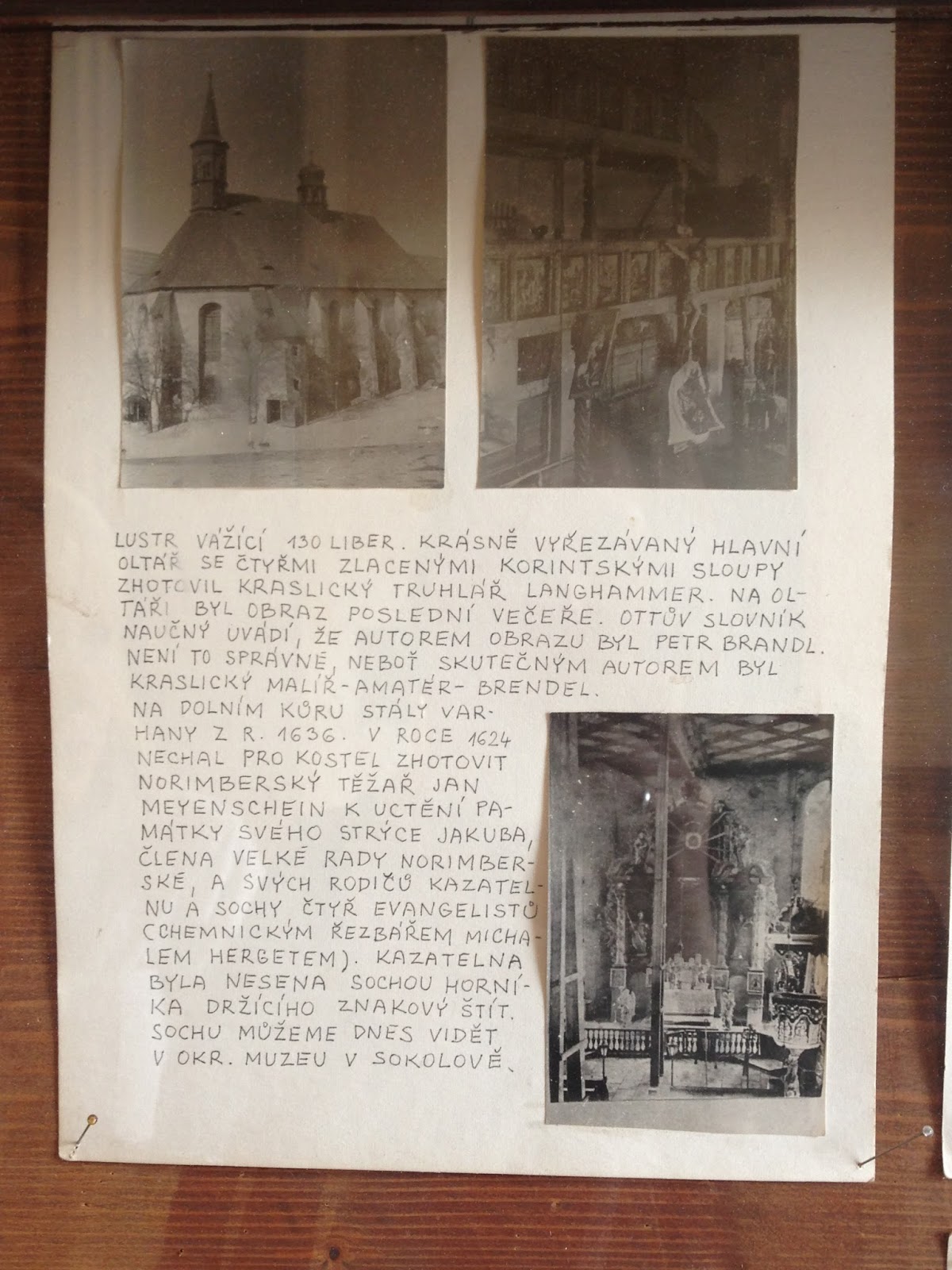
We saw a few handwritten pages and some historical pictures posted at the church, and Stanislav said the church was rebuilt like that from the previous falling down Catholic Church that used to stand there (so the earlier church would have been where they were married), because it was rebuilt from 1893 to 1896. 
The original old church on the left, and the new church on the right.  


It would be interested to have these pages translated to we can read
what they have to say about the history of the church.
Then we asked around until we found the cemetery up on a hill, and we spent quite a while there and didn't even see a quarter of the headstones. There were Czech ones and older German ones, and there were lots with family names: Kohl, Fischer, Breinl, Stowasser, Kohler, and more. 
The Graslitz cemetery.  Pictured here are just a few of the headstones with family names
that we need to figure out exactly how we are related. 


This headstone is one that my parents had found there on a previous trip to the Czech Republic, and we know for sure how these three Breinls are related to us from an old family letter that specifically mentions their names.


And in the back there are piles of old stones all stacked together with moss growing over them. I climbed up on the overgrown piles to see if any names were visible on the piled up stones, and only two were facing up and I think only one of those had a family surname on it. Unfortunately my camera battery ran out, and Mom's battery had already run out, so we couldn't photograph the last few family name headstones we saw.
The overgrown pile of headstones at the back of the cemetery.

Searching through the pile of headstones.
On the drive back we passed through the edge of Bleistadt, now called Olavi, a small town not too far down the road from Graslitz. Friedrich Breinl and his wife lived there at one time, but I didn't have a house number for that town written on my list, and we just drove through without stopping.

Last we stopped at Elbogen, now called Loket.  Elbogen means “elbow” and it's where there's a big curve in the river around this town with a castle. We don't have ancestors in the town of Elbogen that we know of, but some were within the larger Elbogen district. We hadn't planned to stop there, Stanislav just offered to. We went in and pretty quickly left, but it was a colorful little medieval town with a very old looking castle that was built right around a large rock outcropping. There was a wine festival going on inside the castle and it was so crowded you could hardly get around. Stanislav had to beg the guy to let us just go in and take a quick look at the castle without having to pay to get in for the wine festival.
Elbogen (now called Loket)

Mom with Dr. Stanislav Boracovic

The Loket castle

Then we drove back and stopped again in Putschirn where Stanislav's sister, Rose, lives and she had us for coffee (although she was very surprised that we didn't want coffee, tea, wine, or cola). We just asked for water, and she brought out a large water bottle and poured it for us and it was carbonated water. All the water in Europe is carbonated unless you ask for "still water." I don't care for the carbonated stuff – maybe it’d be ok if you were used to having it all the time. I don't think they drink a lot of water here like we do at home.  Oh and she fed us mushrooms she had picked in the woods. They were very good. Stanislav told us Czechs love mushrooms and 95% of them pick their own mushrooms in the woods here. Cool, huh?

Well, that was a nice tour today, and we didn't have any trouble understanding him, and we could almost always figure out what each other was trying to say. Then tonight we had traditional Czech or German food (not sure which) at a place near the hotel in Karlsbad, and I actually like sour krout, and the similar dish of red cabbage, when they are made here, and not something actually sour out of a jar in the U.S.  :)


Well, tomorrow we will go to that church in the morning. . . .  Can't wait!”